
Beyond the Port: Using Flexitanks to Solve the “Last Mile” Water Crisis in Disaster Relief
How modern flexitank logistics can transform emergency humanitarian water delivery when traditional infrastructure collapses.
In the aftermath of floods, earthquakes, typhoons, droughts, and humanitarian crises, the challenge is rarely limited to transporting emergency supplies into a country. In many cases, ports remain operational, airports continue receiving aid flights, and warehouses still function. The true logistical failure often begins after arrival — during the final journey from central distribution hubs to isolated communities.
This stage is commonly referred to as the “last mile” problem, and in disaster relief operations, it can determine whether people receive safe drinking water within hours or suffer dehydration, disease outbreaks, and preventable deaths.
Bulk liquid logistics should not be viewed solely through the lens of industrial transportation and commercial supply chains. The same technologies that improve efficiency in food-grade liquid transport and industrial bulk movement can also become critical humanitarian infrastructure during emergencies.
The Global Water Challenge During Disasters
When disasters strike, water systems are often among the first critical infrastructures to fail. Electricity outages disable pumping stations. Floodwaters contaminate reservoirs. Earthquakes rupture underground pipelines. Roads become inaccessible. In conflict zones, water facilities may even become direct targets.
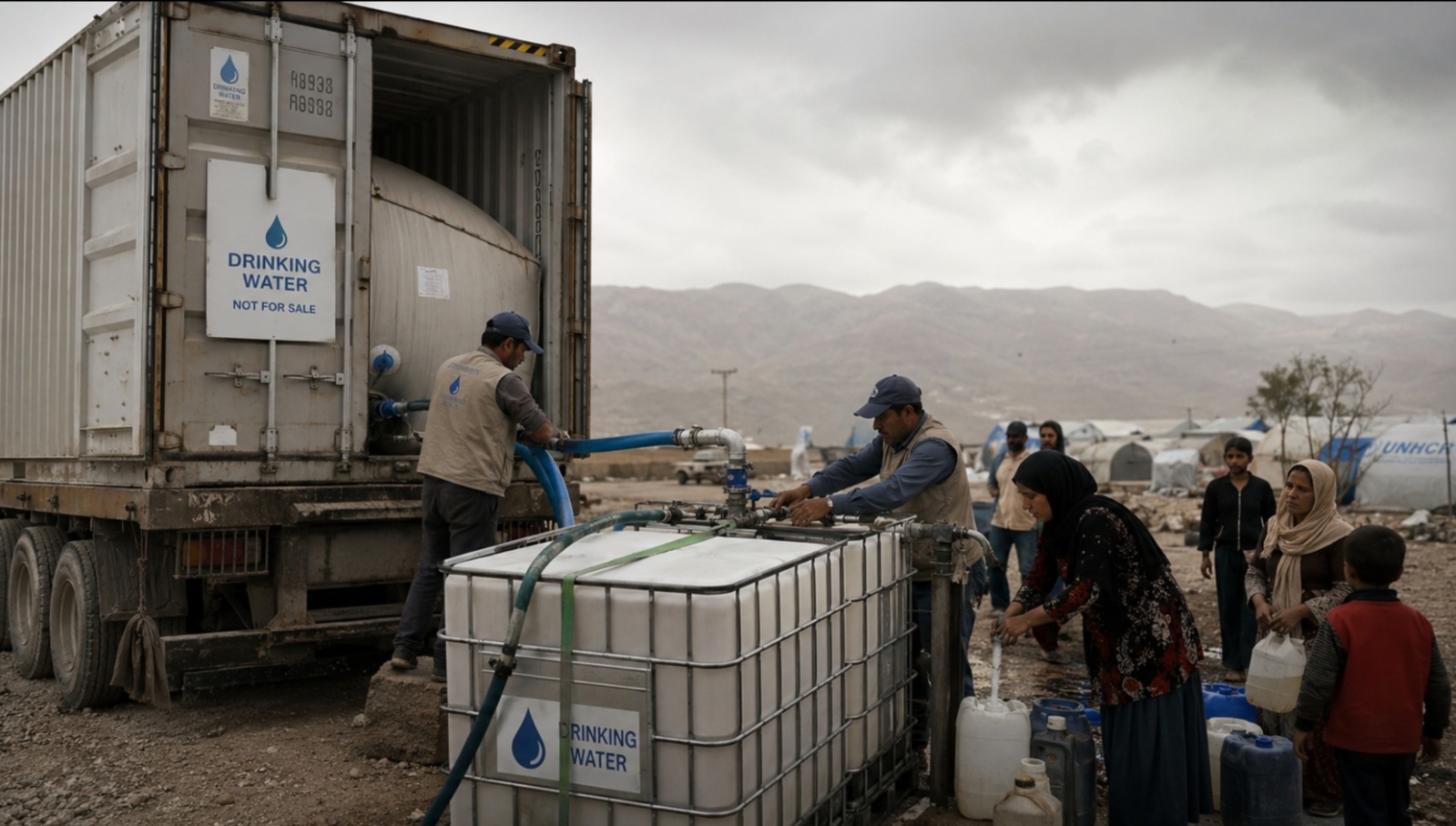
Under these conditions, humanitarian agencies face an enormous operational challenge:
- How can large volumes of potable water be transported quickly?
- How can contamination risks be minimized?
- How can delivery continue when fixed infrastructure no longer exists?
- How can relief operations scale rapidly without relying entirely on bottled water?
Traditional bottled water distribution, while useful in early emergency stages, creates serious limitations:
- High transportation inefficiency
- Large plastic waste generation
- Slow unloading and handling
- Storage congestion at relief hubs
- Increased labor requirements
- Extremely high cost per liter delivered
In large-scale emergencies affecting hundreds of thousands of people, bottled water alone becomes operationally unsustainable.
Why Flexitanks Matter in Humanitarian Logistics
A flexitank is essentially a high-capacity liquid transport system installed inside a standard shipping container. Traditionally used for transporting edible oils, juices, industrial liquids, and non-hazardous chemicals, flexitanks can also be adapted for emergency potable water transportation under appropriate food-grade and sanitation standards.
Instead of transporting thousands of small bottles, a single flexitank container can transport massive quantities of water efficiently across international supply chains.
This changes the economics and operational speed of emergency water distribution dramatically.
Solving the “Last Mile” Crisis
The true innovation is not simply transporting water to a disaster zone. The breakthrough comes from integrating flexitank logistics into decentralized humanitarian distribution strategies.
In practical disaster scenarios, emergency water often arrives at:
- Ports
- Military bases
- Temporary logistics hubs
- Air cargo terminals
- NGO distribution centers
However, affected populations may still be located:
- In flooded villages
- On isolated islands
- Inside collapsed urban districts
- Across mountainous terrain
- Within refugee settlements
- Far from functioning pipelines
Flexitank systems allow humanitarian operators to establish temporary mobile water infrastructure instead of relying exclusively on packaged retail distribution models.
From Bulk Transport to Mobile Distribution Networks
A modern disaster relief strategy can use flexitanks as central liquid storage reservoirs connected to:
- Portable pumping systems
- Mobile filtration units
- Temporary water towers
- Flexible hose networks
- Portable bladder tanks
- Water tanker refill stations
Instead of moving millions of individual bottles, relief organizations can distribute water in bulk at strategic regional nodes and then deploy smaller localized delivery systems to reach vulnerable communities.
This dramatically improves:
| Operational Area | Traditional Bottled Water Approach | Flexitank-Based Bulk Relief Model |
|---|---|---|
| Transport Efficiency | Low | Very High |
| Plastic Waste | Extremely High | Significantly Reduced |
| Unloading Speed | Labor Intensive | Centralized Bulk Handling |
| Scalability | Limited | Rapidly Expandable |
| Storage Congestion | High | Reduced |
| Cost Per Liter | High | Lower |
Operational Realities in the Field
While flexitanks can transport massive quantities of potable water efficiently, effective distribution within disaster zones still requires practical discharge infrastructure.
Depending on terrain and local conditions, humanitarian operators may use:
- Portable diesel or petrol pumps
- Solar-powered pumping systems
- Gravity-fed elevated discharge setups
- Mobile tanker refill stations
- Temporary hose and valve distribution networks
In areas where electricity infrastructure has collapsed, lightweight mobile pumping systems become critical for moving water from centralized flexitank storage points into smaller community-level distribution channels.
This highlights an important reality of disaster logistics: transporting water into a region is only the first step. The true challenge lies in building resilient temporary delivery systems capable of functioning under damaged, unstable, or infrastructure-limited conditions.
Disaster Relief Requires Speed — But Also Stability
One of the lesser-discussed realities of humanitarian logistics is that emergency operations often extend far beyond the first 72 hours.
While early-stage rescue missions dominate media coverage, many communities continue facing water insecurity for weeks or even months after disasters occur.
This creates a transition challenge:
- Short-term survival operations must evolve into stable supply systems
- Temporary aid distribution must become operationally sustainable
- Emergency logistics must support medium-term recovery
Flexitank logistics can play a crucial role during this transitional phase because they support continuous high-volume replenishment without depending entirely on retail packaging supply chains.
Visualizing Emergency Water Scale
The scale of humanitarian water logistics is often difficult to visualize until translated into operational numbers.
Consider a hypothetical regional flood scenario affecting hundreds of thousands of displaced residents across multiple isolated districts.
If a coordinated emergency response deployed 50 standard flexitank containers carrying potable water, the operation could potentially move more than one million liters of water within a single shipping cycle, depending on fill volume and transport configuration.
Under emergency survival benchmarks commonly used in humanitarian planning, that volume could support the short-term daily drinking and essential water needs of hundreds of thousands of people during the most critical phase of a disaster response.
More importantly, the advantage is not limited to volume alone. The real strategic value lies in:
- Rapid international scalability
- Reduced dependence on retail bottled water supply chains
- Lower unloading congestion at relief hubs
- Faster establishment of decentralized emergency water points
- Improved continuity during medium-term recovery operations
In major disasters, logistics capacity itself becomes humanitarian infrastructure. The ability to move, store, and distribute water efficiently can directly influence operational resilience, public health stability, and survival outcomes during the most vulnerable stages of a crisis.
Environmental Sustainability During Humanitarian Operations
Disaster relief itself can unintentionally generate environmental damage.
Large-scale bottled water operations frequently leave behind enormous quantities of plastic waste, particularly in regions where waste management systems are already compromised.
This creates secondary public health and environmental problems:
- Accumulation of plastic debris
- Blocked drainage systems
- Contaminated waterways
- Long-term waste disposal challenges
It is also important to acknowledge that many flexitank liners themselves are designed for single-use operations due to hygiene, contamination prevention, and safety requirements. However, the polyethylene (PE) and polypropylene (PP) materials commonly used in flexitank construction can often enter recycling streams depending on local recycling capabilities and contamination levels.
Even with single-use liners, bulk liquid transport can still significantly reduce overall plastic waste generation compared to distributing millions of small individual bottles during prolonged humanitarian operations.
The Role of Private Sector Logistics in Humanitarian Response
Modern disaster response increasingly depends on cooperation between governments, NGOs, military logistics units, shipping operators, and private-sector supply chain specialists.
The logistics industry possesses capabilities that are often underutilized in humanitarian planning:
- Container transport expertise
- Bulk liquid handling systems
- Rapid deployment infrastructure
- Cross-border shipping coordination
- Operational scalability
- International supply chain experience
Companies involved in bulk liquid transportation already operate within complex global logistics environments. This experience becomes highly valuable when emergency conditions require fast adaptation under pressure.
At LAF Flexitank Services Sdn Bhd, we believe logistics innovation should not be viewed only as a commercial advantage. It should also be recognized as a tool capable of supporting resilience, humanitarian preparedness, and disaster recovery.
Preparing Before the Next Crisis
The world is entering an era where climate-related disasters, water shortages, infrastructure failures, and humanitarian emergencies are becoming increasingly frequent.
Floods across Southeast Asia, drought conditions in multiple regions, and the growing intensity of extreme weather events demonstrate that traditional emergency supply models alone may no longer be sufficient.
Future humanitarian preparedness requires:
- Scalable logistics systems
- Flexible deployment models
- Rapid international transport capabilities
- Reduced dependency on fragmented packaging supply chains
- Efficient bulk liquid distribution solutions
Flexitanks are not a replacement for all humanitarian water delivery methods. However, they represent a powerful complementary logistics solution capable of strengthening emergency response capacity on a much larger scale.
Looking Beyond Commercial Logistics
The logistics industry is often associated with efficiency, cost reduction, and industrial supply chains. Yet during humanitarian crises, logistics becomes something far more important:
It becomes the system that determines whether essential resources reach people in time.
In many disasters, the greatest challenge is not global supply availability. The challenge is operational distribution beyond damaged infrastructure and broken delivery systems.
That is where modern bulk liquid logistics can make a meaningful difference.
By combining containerized transport, scalable liquid handling systems, and decentralized emergency distribution strategies, flexitank technology has the potential to support faster, cleaner, and more resilient humanitarian water delivery in some of the world’s most difficult conditions.