
LAF Bulk Packaging FAQ
Collapsible Paper IBC FAQ: Complete Guide to Bulk Liquid and Dry Cargo Packaging
This page answers the most common questions about LAF Collapsible Paper IBC, including capacity, bulk liquid cargo, selected dry bulk cargo, food-grade use, loading and discharge, warehouse storage savings, container utilization, sustainability, S-Series, R-Series, and how to choose the right paper IBC solution for your supply chain.
LAF Collapsible Paper IBC is designed for businesses that need a practical alternative to drums, rigid IBCs, and other traditional bulk packaging formats. It combines a reinforced paper-based outer structure with suitable liner options to support safe and efficient transport of compatible non-hazardous bulk liquid and selected dry cargo.
For manufacturers, exporters, distributors, food and beverage producers, industrial oil suppliers, chemical companies, warehouse operators, and logistics teams, packaging is not only a container. It affects freight cost, warehouse space, handling time, product safety, carbon footprint, and overall supply chain efficiency.
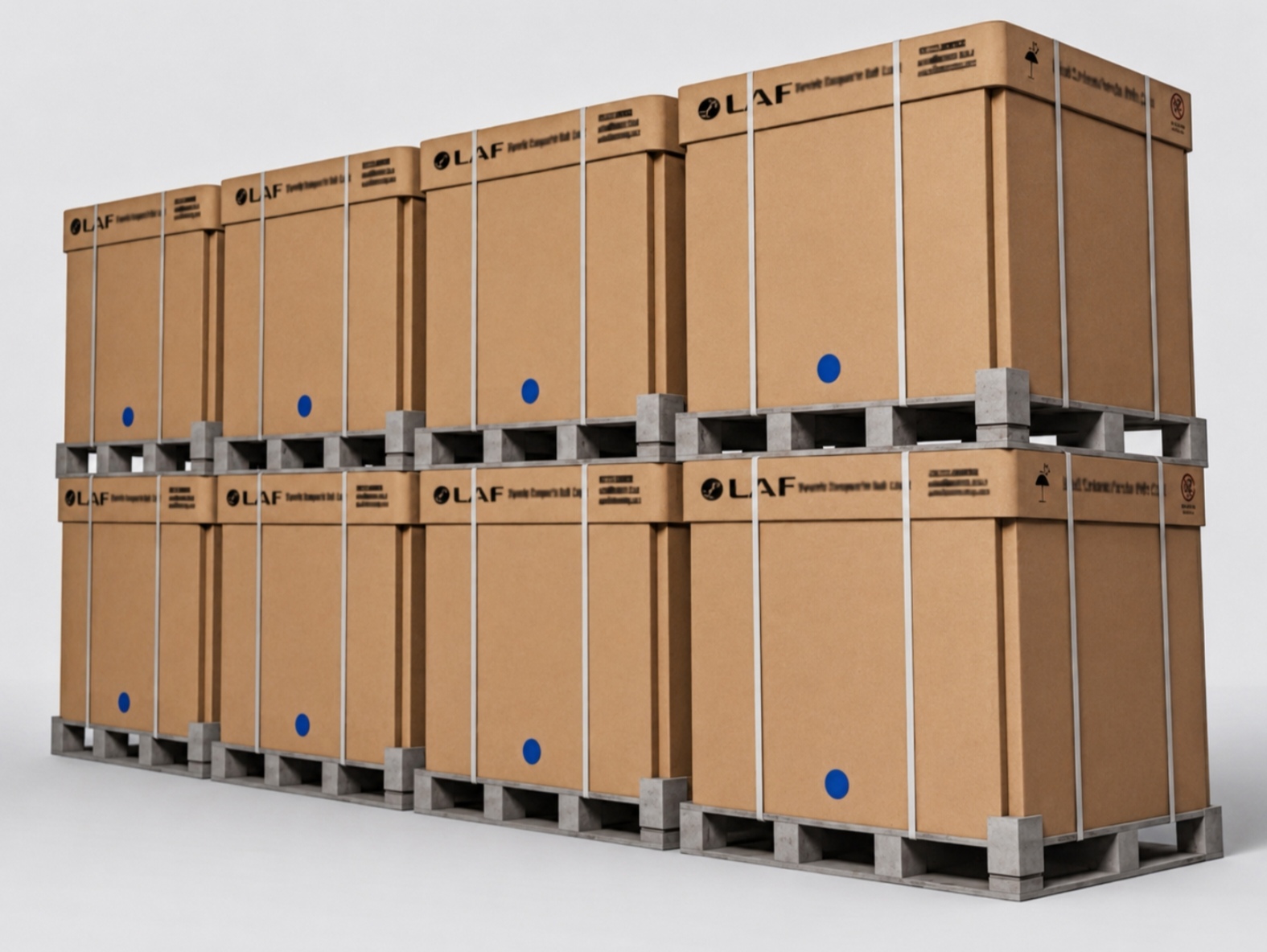
High Strength
Reinforced paper-based structure designed for suitable bulk packaging applications.
Large Volume
Up to 1000L class packaging for suitable cargo and operating conditions.
Collapsible Design
Folds after use to reduce empty storage and return logistics pressure.
Sustainable Packaging
Renewable and recyclable carton-based structure for ESG-focused supply chains.
General Questions About LAF Collapsible Paper IBC
1. What is a Collapsible Paper IBC?
A Collapsible Paper IBC is an intermediate bulk container made with a reinforced paper-based outer structure and a suitable inner liner. It is designed to transport compatible non-hazardous bulk liquid or selected dry cargo while improving storage efficiency, handling convenience, and logistics cost control.
2. What does IBC mean?
IBC stands for Intermediate Bulk Container. It is a bulk packaging format larger than small containers or drums, while still being practical for palletized handling, warehouse movement, and containerized transportation.
3. Why is it called collapsible?
It is called collapsible because the empty structure can be folded after use. This reduces empty packaging volume and helps businesses save warehouse space compared with drums and rigid IBCs that remain bulky even when empty.
4. What is the main purpose of LAF Collapsible Paper IBC?
Its main purpose is to provide a strong, space-efficient, cost-effective, and environmentally responsible packaging solution for compatible non-hazardous bulk cargo. It helps companies improve container utilization, reduce storage requirements, and simplify logistics planning.
5. Is Collapsible Paper IBC a replacement for drums?
Yes, in suitable applications, Collapsible Paper IBC can replace drums by reducing packaging unit quantity, improving bulk handling, increasing payload efficiency, and lowering empty packaging storage requirements.
6. Is Collapsible Paper IBC a replacement for rigid IBC?
It can be an alternative to rigid IBCs for selected non-hazardous products. Unlike rigid IBCs, empty collapsible paper IBCs can be folded, which helps reduce storage and return logistics challenges.
Capacity, Payload and Container Utilization
7. How much can LAF Collapsible Paper IBC hold?
LAF Collapsible Paper IBC can support up to 1000L class packaging for suitable applications, depending on product type, liner selection, cargo density, model, handling method, and operating conditions.
8. Why does 1000L capacity matter?
Higher capacity helps companies move more product with fewer packaging units. Compared with packaging arrangements that may carry around 800L in a similar space, a 1000L paper IBC can improve product density and reduce logistics cost per litre in suitable applications.
9. Can Collapsible Paper IBC increase product per cubic meter?
Yes. In suitable operations, it can improve product per cubic meter by allowing more product to be packed into a compact bulk packaging format. This supports better warehouse usage, improved container loading, and lower transport cost per unit of product.
10. Does Collapsible Paper IBC improve container utilization?
Yes. Its large-volume design and palletized handling can reduce wasted space in containerized transport. Better container utilization is important for exporters, manufacturers, and distributors shipping bulk cargo by road, rail, or ocean freight.
11. Can a standard 20-foot container carry more product with Paper IBC?
In many suitable applications, a standard 20-foot container can carry more payload using collapsible paper IBC compared with traditional drum-based packaging. Actual loading depends on cargo density, packaging specification, pallet configuration, container condition, and weight limits.
12. Is it suitable for high-load cargo?
Yes. The reinforced paper-based structure is designed for high load capacity under suitable operating conditions. The cargo must be compatible, non-hazardous, and handled according to recommended filling, storage, and transportation procedures.
More Product in the Same Logistics Footprint
For many bulk cargo operations, the real cost is not only the packaging itself. It is also the space taken inside a container, the area occupied inside a warehouse, and the number of times empty packaging must be handled. LAF Collapsible Paper IBC helps improve product density and space utilization throughout the supply chain.
Applications and Suitable Cargo
13. What products can be packed in LAF Collapsible Paper IBC?
It can be used for compatible non-hazardous bulk liquid and selected dry cargo. Common application areas include food and beverage products, edible oils, syrups, juices, wine, industrial oils, lubricants, base oils, glycols, emulsions, plant extracts, nutrient liquids, and selected non-hazardous chemical products.
14. Is it suitable for bulk liquid cargo?
Yes. LAF Collapsible Paper IBC is suitable for selected non-hazardous bulk liquid cargo when paired with the correct inner liner, filling system, discharge method, and product compatibility assessment.
15. Is it suitable for dry bulk cargo?
Yes. It may be suitable for selected dry bulk cargo such as powders, granules, and solid bulk materials, depending on product characteristics, packaging requirements, liner selection, and handling method.
16. Can it be used for food and beverage products?
Yes. With the correct food-grade liner and proper handling procedures, it can be used for suitable food and beverage products such as edible oils, fruit juices, syrups, wine, sauces, and compatible liquid food ingredients.
17. Can it be used for edible oil?
Yes. Edible oil is one of the common product categories for bulk liquid packaging when the correct liner and hygiene controls are used.
18. Can it be used for fruit juice and syrup?
Yes. Compatible fruit juice, syrup, and similar food-grade liquid products may be transported using the correct liner and appropriate filling and discharge procedures.
19. Can it be used for wine?
Yes. Wine may be suitable when the correct liner, filling condition, oxygen control requirement, hygiene practice, and cargo compatibility are confirmed.
20. Can it be used for lubricants and base oils?
Yes. Compatible lubricants, base oils, and selected industrial oil products can be packed using suitable liner systems and proper handling procedures.
21. Can it be used for glycols?
Selected glycols may be suitable if they are non-hazardous, compatible with the liner, and handled under suitable operating conditions.
22. Can it be used for chemicals?
It can be used for selected non-hazardous chemicals such as compatible emulsions, plant extracts, nutrient liquids, and other approved liquid products.
23. Can hazardous products be transported?
LAF Collapsible Paper IBC is intended for compatible non-hazardous cargo. Hazardous products require separate packaging assessment, regulatory compliance, and specialized packaging solutions.
Bulk Liquid Cargo
Suitable for selected non-hazardous liquids with appropriate liner and handling procedures.
Dry Bulk Cargo
Suitable for selected powders, granules, and compatible dry bulk materials.
Food & Beverage
Applicable for edible oils, juices, syrups, wine, sauces, and liquid food ingredients.
Industrial Products
Applicable for lubricants, base oils, glycols, emulsions, and compatible non-hazardous chemicals.
Food Grade and Product Safety
24. Is LAF Collapsible Paper IBC food grade?
It can be configured for food-grade applications when used with suitable food-grade liner materials and proper handling procedures.
25. Does the paper structure touch the product?
No. For liquid cargo, the product is contained inside the inner liner. The reinforced paper-based outer structure provides support and protection, while the liner provides the product-contact layer.
26. Why is liner selection important?
Liner selection is critical because the liner comes into contact with the product. The correct liner helps protect cargo quality, reduce contamination risk, and support compatibility with the product being packed.
27. Can one liner be used for all products?
No. Different products may require different liner materials, barrier properties, valve arrangements, and handling procedures.
28. What should be checked before using Paper IBC for food cargo?
Important checks include product compatibility, food-grade liner suitability, filling temperature, viscosity, discharge method, hygiene requirements, transport route, storage condition, and unloading equipment.
Loading, Discharge and Handling
29. How is LAF Collapsible Paper IBC filled?
The IBC is assembled, positioned correctly, fitted with the suitable liner, and filled through the designated loading port.
30. How is the cargo discharged?
Cargo is discharged through the designated discharge outlet or valve arrangement. The discharge method depends on product viscosity, liner design, equipment setup, and site operation.
31. Is it compatible with standard pumping equipment?
Yes. LAF Collapsible Paper IBC can be supplied with loading and discharge interfaces designed to support practical operation with standard pumping equipment in suitable industrial environments.
32. Is it easy to assemble?
Yes. It is designed for practical assembly and handling. Proper training, correct pallet condition, suitable site setup, and careful handling help ensure stable and efficient operation.
33. Does it require special equipment?
It usually does not require highly specialized equipment for normal handling, but suitable pallet handling equipment, filling equipment, discharge equipment, and safe operating procedures are still required.
34. Can it be moved by forklift?
Yes, when properly placed on a suitable pallet and handled according to safe warehouse procedures.
35. Can it be stacked?
Stacking suitability depends on product weight, IBC model, pallet condition, warehouse condition, filling status, handling method, and transport requirements.
Designed for Practical Filling and Discharge
Efficient bulk packaging must be easy to fill, move and discharge. LAF Collapsible Paper IBC can be supplied with suitable loading and discharge interfaces to support practical operation in production, warehouse and logistics environments.
Storage, Warehousing and Empty Packaging Savings
36. How does Collapsible Paper IBC save warehouse space?
After discharge, the empty IBC can be collapsed into a compact form. This reduces the amount of space required for empty packaging and helps warehouses improve floor utilization.
37. How much empty storage space can be saved?
In many storage arrangements, empty collapsible paper IBCs can occupy less than one-third of the space required by drums or rigid IBCs.
38. Why is empty packaging storage expensive?
Empty drums and rigid IBCs consume space even when they no longer hold product. This can increase warehouse rent, handling time, inventory congestion, and return logistics cost.
39. Is Collapsible Paper IBC useful for warehouses with limited space?
Yes. It is especially useful for warehouses that need to reduce empty packaging volume, improve inventory flow, and avoid unnecessary space being occupied by rigid empty containers.
40. Can it reduce return logistics?
Yes. Because empty units can be collapsed, businesses can reduce the transport volume associated with empty packaging recovery, storage, or disposal.
41. Does it help reduce handling time?
It can help reduce handling time by using fewer bulk packaging units compared with many small drums, and by simplifying empty packaging storage after discharge.

Sustainability, ESG and Environmental Benefits
42. Is Collapsible Paper IBC environmentally friendly?
It is an environmentally responsible packaging option because the outer structure is paper-based, renewable, and recyclable. It also helps reduce empty transport volume.
43. How does it support ESG goals?
It supports ESG goals by reducing reliance on rigid packaging, improving transport efficiency, reducing empty storage volume, supporting recyclable material use, and helping companies reduce unnecessary logistics movements.
44. Is the carton structure recyclable?
Yes, the carton-based outer structure is designed around renewable and recyclable paper-based material. Recycling practices may depend on local facilities, product residue, liner handling, and waste management regulations.
45. Does it reduce carbon footprint?
It can help reduce carbon footprint by improving payload efficiency and reducing the movement of empty packaging.
46. Why does packaging affect carbon emissions?
Packaging affects carbon emissions because it influences container utilization, transport frequency, warehouse space, empty packaging return volume, and handling operations.
47. Is it better than drums for sustainability?
In many suitable applications, it can offer sustainability advantages compared with drums by reducing packaging units, improving product density, reducing empty storage space, and using a renewable paper-based outer structure.
Paper IBC Models and Selection
48. What types of LAF Collapsible Paper IBC are available?
LAF Collapsible Paper IBC is available in square and rectangular formats to match pallet type, cargo requirements, warehouse layout, and transportation plans.
49. What is S-Series Square Paper IBC?
S-Series Square Paper IBC is designed for square pallet compatibility. It is suitable for operations that prefer a square footprint for storage, stacking, pallet movement, and container loading.
50. What is R-Series Rectangular Paper IBC?
R-Series Rectangular Paper IBC is designed for rectangular pallet compatibility. It is useful for operations that require a rectangular footprint to suit specific warehouse, transport, or container-loading arrangements.
51. How do I choose between S-Series and R-Series?
The right choice depends on pallet type, cargo density, warehouse layout, container loading plan, handling equipment, route, and discharge requirements.
52. Does the liner differ by product?
Yes. Liner selection may differ depending on whether the cargo is food-grade liquid, industrial oil, chemical product, dry bulk product, viscous liquid, or sensitive ingredient.
International Shipping and Logistics
53. Is Collapsible Paper IBC suitable for international shipping?
Yes. It is suitable for standard containerized shipments across road, rail, and ocean freight networks when the cargo, packaging configuration, pallet, container, and handling procedures are appropriate.
54. Can it be used in a 20-foot container?
Yes. It can be used in standard containerized transport, including 20-foot containers, depending on cargo weight, loading plan, pallet arrangement, and transport regulations.
55. Is it suitable for export packaging?
Yes. It is suitable for exporters that need efficient bulk packaging for compatible non-hazardous cargo.
56. Does it reduce freight cost?
It can reduce freight cost by improving product density, reducing packaging units, improving container utilization, and reducing empty packaging transport volume.
57. Does it reduce logistics complexity?
Yes. Fewer packaging units, collapsible empty storage, practical filling and discharge, and improved container utilization can simplify logistics planning.
58. Can it be used for road, rail and sea freight?
Yes. It can be used across road, rail, and ocean freight networks when the cargo, route, container condition, loading method, and handling procedures are suitable.
Comparison With Drums and Rigid IBC
| Question | Collapsible Paper IBC Advantage |
|---|---|
| How does it compare with drums? | Fewer packaging units, better space efficiency, easier bulk handling, and reduced empty storage volume. |
| How does it compare with rigid IBC? | Collapsible empty structure helps reduce storage and return logistics challenges. |
| How does it affect warehouse space? | Empty units can be folded to reduce empty packaging footprint. |
| How does it affect freight cost? | Better payload density and fewer empty transport movements can reduce logistics cost. |
| How does it affect sustainability? | Renewable and recyclable paper-based structure supports lower-waste packaging strategies. |
59. Why choose Collapsible Paper IBC instead of drums?
Choose Collapsible Paper IBC when you want better space utilization, fewer packaging units, easier bulk handling, reduced empty storage, and stronger sustainability performance for compatible non-hazardous cargo.
60. Why choose Collapsible Paper IBC instead of rigid IBC?
Choose Collapsible Paper IBC when empty packaging storage and return logistics are major concerns. Rigid IBCs remain bulky when empty, while paper IBCs can be collapsed after discharge.
Industries That Use Collapsible Paper IBC
For edible oils, juices, syrups, wine, sauces, and liquid ingredients.
For lubricants, base oils, glycols, and compatible non-hazardous oil products.
For selected non-hazardous emulsions, extracts, nutrient liquids, and compatible products.
For containerized international shipping and better bulk packaging efficiency.
For reducing empty packaging space and improving storage flow.
For flexible bulk packaging operations across multiple compatible product categories.
Important Suitability Checks Before Use
- Confirm that the cargo is non-hazardous and compatible with the selected liner.
- Check whether the product is liquid, dry bulk, viscous, sensitive, or food-grade.
- Confirm filling temperature, discharge method, and pumping equipment requirements.
- Check pallet type, warehouse layout, forklift handling, and storage condition.
- Confirm container condition, transport route, and loading plan.
- Use proper installation, filling, discharge, and handling procedures.
- For food-grade cargo, confirm hygiene controls and food-contact suitability.
Buying and Consultation Questions
61. How do I know if Collapsible Paper IBC is suitable for my cargo?
You should review cargo type, product density, viscosity, filling temperature, liner compatibility, discharge method, transport route, storage condition, and required packaging capacity.
62. What information should I provide when requesting a quotation?
Useful information includes product name, cargo type, liquid or dry cargo form, density, volume per shipment, food-grade requirement, filling temperature, discharge method, loading location, destination, container type, pallet requirement, and expected shipment frequency.
63. Can LAF recommend the right model?
Yes. LAF Flexitank Services Sdn Bhd can review your cargo, packaging requirements, warehouse operation, shipping route, and business goals to recommend a suitable collapsible paper IBC solution.
64. Can it be combined with other LAF bulk packaging solutions?
Yes. Depending on your cargo and transport mode, Collapsible Paper IBC may be considered alongside other LAF solutions such as flexitank, IBC liner, dry bulk liner, and other bulk packaging systems.
65. Who should use Collapsible Paper IBC?
It is suitable for manufacturers, exporters, distributors, food and beverage producers, industrial oil suppliers, non-hazardous chemical companies, warehouse operators, and logistics teams looking for better bulk packaging efficiency.
Why Choose LAF Flexitank Services Sdn Bhd?
LAF Flexitank Services Sdn Bhd supports customers with practical bulk packaging solutions for modern supply chains. Our team can help you evaluate cargo suitability, packaging configuration, liner requirements, filling and discharge method, container loading, and logistics efficiency.
- Bulk packaging experience for liquid and selected dry cargo logistics
- Support for product suitability and cargo compatibility review
- Guidance on liner selection, filling method, and discharge arrangement
- Solutions for food and beverage, industrial oils, and non-hazardous chemicals
- Support for container utilization, storage savings, and export packaging planning
- Access to related bulk packaging solutions including flexitank and IBC liner
Tell Us About Your Cargo
To recommend the right Collapsible Paper IBC solution, our team may ask for the following details:
Quick Summary: Why Choose LAF Collapsible Paper IBC?
- Designed for compatible non-hazardous bulk liquid and selected dry cargo
- Suitable for food and beverage, industrial oils, and selected non-hazardous chemicals
- Up to 1000L class packaging for suitable applications
- Improves product density and container utilization
- Collapsible design reduces empty packaging storage space
- Can reduce return logistics and empty packaging movement
- Supports standard pumping compatibility through suitable loading and discharge interfaces
- Uses renewable and recyclable carton-based outer structure
- Supports ESG, sustainability, and lower-carbon logistics goals
- Available in square and rectangular configurations for different pallet and warehouse needs
Ask LAF About Collapsible Paper IBC for Your Cargo
Speak with LAF Flexitank Services Sdn Bhd to find out whether Collapsible Paper IBC is suitable for your product, shipment route, filling method, discharge system, warehouse operation, and sustainability goals.
Our team can review your cargo type, liner requirements, packaging volume, pallet configuration, transport route, and operational needs before recommending the most suitable bulk packaging solution.