
Sustainability Insight
The Hidden Cost of Empty Logistics: Why Bulk Packaging Is Becoming a Sustainability Strategy
How modern flexitanks, dry bulk liners, and recyclable bulk packaging systems help reduce unnecessary transport movements, packaging waste, warehouse pressure, and operational inefficiency across global supply chains.
In global logistics, waste is often discussed in terms of packaging material. But one of the largest forms of waste is less visible: empty movement. Empty drums, empty rigid containers, empty return trips, idle warehouse space, repeated handling, cleaning wastewater, and unnecessary logistics links all add cost and environmental pressure to the supply chain. Modern bulk packaging is changing this conversation by showing that sustainability is not only about what packaging is made from. It is also about how intelligently cargo moves.
The Problem Few Companies Measure: Empty Logistics
Many companies carefully measure freight rates, packaging cost, container availability, warehouse rent, and delivery time. Yet the hidden cost of empty logistics is often overlooked. Empty logistics refers to all movements, spaces, materials, and processes that do not directly carry saleable cargo but still consume money, labor, energy, and operational attention.
In traditional bulk liquid and dry bulk transport, empty logistics can appear in many forms. Drums must be transported before filling, stored before use, handled during loading, moved after discharge, cleaned or disposed of, and sometimes returned or recycled through separate channels. Rigid intermediate containers create similar concerns. Even when these systems work properly, they often create many extra logistics steps around the actual cargo movement.
The issue is not only environmental. It is also commercial. Every unnecessary handling stage can increase labor cost. Every empty return can reduce transport efficiency. Every rigid packaging unit can consume warehouse space. Every cleaning process can generate wastewater or disposal obligations. Every additional movement can introduce delay, damage risk, documentation work, and scheduling complexity.
Core Idea
The most sustainable logistics system is not always the one with the strongest packaging. It is often the one that removes unnecessary movements, empty returns, repeated handling, and avoidable waste from the supply chain.
Why Traditional Packaging Creates More Than Material Waste
When people compare packaging systems, they often focus on the visible object: a drum, a rigid IBC, a liner, a flexitank, or a carton-based bulk container. But the true environmental and operational impact of packaging extends far beyond the object itself.
Traditional rigid packaging can create a chain of secondary activities. It must be manufactured, shipped empty, stored, filled, loaded, unloaded, cleaned, returned, refurbished, disposed of, or recycled. Each stage uses resources. Each stage requires space. Each stage creates operational dependency.
This is why modern packaging strategy is moving away from simply asking, “What is the packaging cost?” A better question is, “What total logistics burden does this packaging system create?”
In bulk transport, a packaging system should be judged by the whole journey. It should be evaluated according to cargo capacity, loading efficiency, transport compatibility, contamination control, discharge performance, storage impact, recyclability, empty return requirements, and waste treatment consequences.
| Hidden Cost Area | How It Appears in Logistics | Why It Matters |
|---|---|---|
| Empty movement | Empty drums, rigid containers, or returnable units moving without cargo | Consumes fuel, freight capacity, and scheduling resources |
| Warehouse pressure | Packaging inventory occupying storage space before or after use | Increases facility cost and reduces operational flexibility |
| Handling labor | Repeated movement of many individual packaging units | Adds time, labor, equipment use, and damage risk |
| Cleaning waste | Container washing, wastewater, and residue treatment | Creates environmental and compliance cost |
| Operational links | Extra stages between origin and destination | Increases complexity, delay exposure, and coordination burden |
Why Fewer Logistics Links Can Mean a Cleaner Supply Chain
Every logistics link creates work. Some work is necessary. Cargo must be loaded, transported, discharged, documented, and received. But many supply chains contain additional links created by packaging limitations rather than cargo requirements.
For example, smaller packaging units often require repeated filling, stacking, palletizing, securing, counting, unloading, destuffing, and disposal. These activities may be normal, but they are not always efficient. When cargo can move in bulk through a properly engineered containerized system, many of these extra handling stages can be reduced.
Flexitanks and dry bulk liners are important because they allow standard containers to carry bulk cargo more directly. Instead of moving cargo through many individual packaging units, the container itself becomes the transport platform. This can reduce the number of operational contacts between cargo and the outside environment.
Fewer logistics links can support better efficiency, cleaner handling, lower exposure to contamination, and reduced coordination complexity. In ESG terms, this matters because simpler movement often means lower resource consumption.
Supply Chain Perspective
Reducing logistics links is not only about speed. It is about removing unnecessary handling, lowering exposure to operational error, reducing waste sources, and improving the overall movement quality of the supply chain.
Flexitanks and the Reduction of Empty Returns
One of the most important advantages of flexitank logistics is the way it changes the empty-return problem. Traditional returnable packaging systems often require transport capacity even after the cargo has been delivered. Empty units must be repositioned, cleaned, stored, or returned to circulation.
In contrast, a flexitank system uses a standard shipping container as the structural transport platform. After the cargo is discharged and the used flexitank is properly handled according to disposal or recycling procedures, the container can re-enter the normal container logistics network. This helps avoid the burden of returning a specialized tank or large numbers of empty packaging units.
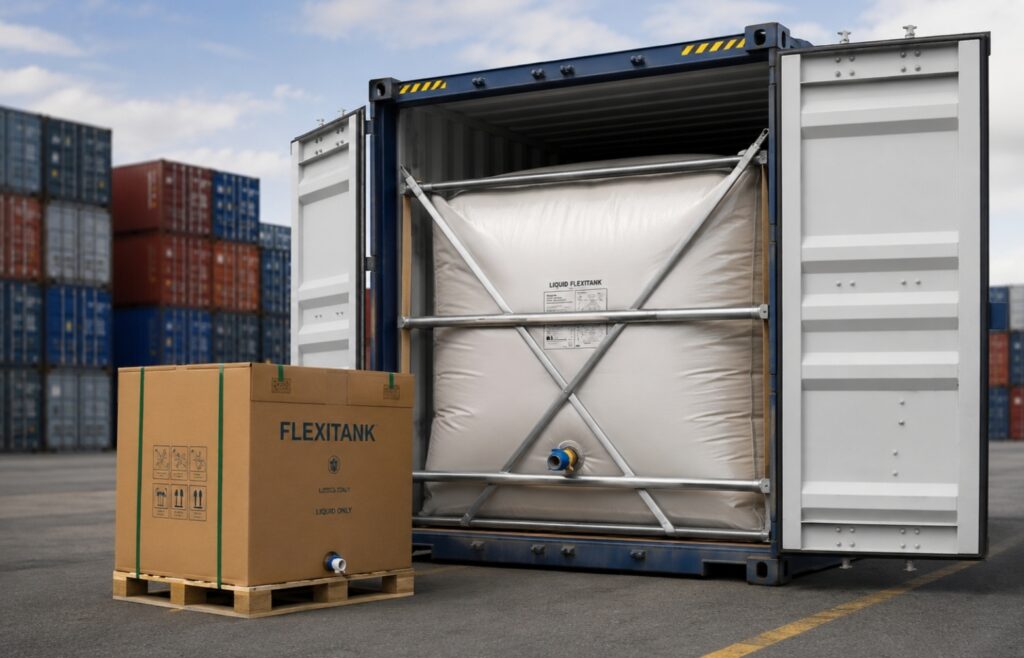
Empty return reduction is a major logistics efficiency issue because transport assets are most valuable when they carry revenue-generating cargo. Empty movements consume fuel, driver time, equipment availability, and scheduling capacity without moving useful product.
For companies concerned about carbon footprint, empty returns should not be ignored. Reducing unnecessary empty movement is one of the most practical ways to improve transport efficiency.
Why Warehouse Space Is Part of Sustainability
Warehouse space is often treated as a real estate or inventory issue, but it is also part of sustainability. Every square meter of warehouse space has an operational cost. It requires construction, lighting, equipment, labor movement, safety management, and ongoing maintenance.
Rigid packaging systems can occupy significant warehouse space before and after use. Empty drums, rigid IBCs, pallets, and support materials may need to be stored before filling. After discharge, some units require temporary storage before cleaning, return, disposal, or recycling.
Collapsible and flexible bulk packaging systems can help reduce this burden. When packaging occupies less space before use and creates fewer bulky empty units after use, the warehouse becomes more efficient.
This matters because warehouse efficiency affects the entire supply chain. Less space pressure can improve inventory flow, reduce congestion, simplify handling, and allow companies to use facility capacity more effectively.
| Packaging Approach | Warehouse Impact | Operational Meaning |
|---|---|---|
| Rigid drums | Require physical storage before and after use | Higher space pressure and more handling |
| Rigid IBCs | Occupy substantial space even when empty | More storage planning and return coordination |
| Flexitanks | Compact before use and installed inside standard containers | Better integration with containerized logistics |
| Collapsible IBC systems | Can reduce storage footprint compared with rigid alternatives | Improved warehouse utilization |
The Circular Economy View of Bulk Packaging
Circular economy thinking encourages companies to reduce waste, use resources more efficiently, and design systems that support recovery, recycling, reuse, and responsible disposal. In bulk packaging, this means looking beyond the first shipment.
A packaging system should be evaluated according to what happens before use, during use, and after use. Does it reduce unnecessary material? Does it lower transportation waste? Does it avoid cleaning wastewater? Can components be recycled where suitable facilities exist? Does it reduce bulky waste at the destination?
Flexitanks, dry bulk liners, and paper-based IBC systems can contribute to circular economy objectives when used in appropriate cargo scenarios and supported by proper recycling or disposal channels.
The circular economy is not simply about using recyclable materials. It is about designing the entire logistics cycle so that resources flow more intelligently and waste is reduced at multiple points.
Important Distinction
A recyclable material is useful, but a truly circular logistics strategy also considers transport efficiency, waste avoidance, storage reduction, cleaning reduction, and responsible end-of-life handling.
How Dry Bulk Liners Fit Into the Same Sustainability Logic
The same logic applies to dry bulk cargo. Dry bulk liners allow standard containers to transport powders, granules, agricultural products, food ingredients, and selected non-hazardous dry cargoes more efficiently.
Instead of relying on large numbers of smaller bags or rigid containers, a liner can transform the container into a bulk transport system. This may reduce handling, improve loading and discharge efficiency, protect cargo from contamination, and support cleaner transport operations.
In many supply chains, dry bulk liners can help improve the transport environment by reducing loose material exposure, lowering dust-related handling concerns, and supporting a more controlled loading and unloading process.
This makes dry bulk liners part of the broader shift from packaging as a product to packaging as a logistics efficiency system.
Why Food-Grade Logistics Needs Cleaner Systems
Food-grade cargo transportation adds another layer to the sustainability discussion. For food-grade liquids and dry bulk ingredients, packaging must support hygiene, contamination prevention, and controlled handling.
A cleaner logistics system is not only environmentally useful. It also protects cargo quality. When cargo moves through fewer handling stages and remains inside a controlled packaging environment, the risk of contamination exposure can be reduced.
Food-grade logistics therefore benefits from packaging systems that combine hygiene, efficiency, and operational control. Flexitanks and liners can support this objective when selected correctly, installed properly, and used according to technical guidance.
The future of food logistics will likely place greater emphasis on packaging systems that reduce handling complexity while maintaining strict cargo protection standards.
ESG Is Becoming Operational, Not Decorative
ESG is sometimes discussed in broad corporate language, but in logistics it becomes very practical. It appears in fuel consumption, packaging waste, labor conditions, warehouse efficiency, route planning, cleaning processes, recycling systems, and cargo handling safety.
In bulk logistics, ESG improvement does not always require dramatic changes. Sometimes it begins with removing inefficient steps from the transport chain.
Reducing empty movement, improving cargo loading efficiency, minimizing wasteful packaging, supporting recyclable materials, lowering cleaning wastewater, and simplifying transport links are all practical ESG actions.
This is why bulk packaging is becoming a sustainability strategy. The right packaging system can influence environmental impact, social working conditions, and operational governance at the same time.
| ESG Area | Bulk Packaging Contribution |
|---|---|
| Environmental | Reduced packaging waste, fewer empty returns, less cleaning wastewater, better transport efficiency |
| Social | Cleaner handling environments, less manual movement of many small units, reduced dust exposure in suitable dry bulk systems |
| Governance | Better process control, clearer technical guidance, more traceable logistics practices, responsible end-of-life planning |
The Future: Packaging Designed Around the Whole Journey
The future of bulk packaging will not be defined only by stronger materials or larger capacity. It will be defined by how effectively packaging supports the whole logistics journey.
This means future packaging systems will be evaluated according to how they perform from storage before use to installation, loading, transport, discharge, recycling, and final disposal.
In this future, the best packaging systems will not simply hold cargo. They will reduce unnecessary logistics, improve sustainability, support cleaner operations, save space, reduce handling, and make global movement more efficient.
The companies that understand this shift will see packaging not as a minor operating expense, but as a strategic tool for supply chain transformation.
From Packaging Waste to Logistics Intelligence
The hidden cost of logistics is often found in what moves without purpose: empty containers, empty drums, empty return trips, unused warehouse space, unnecessary handling, and avoidable waste. Modern bulk packaging systems help address this problem by making cargo movement more direct, more efficient, and more aligned with circular economy thinking. In the future, sustainable logistics will depend not only on better materials, but on smarter systems that remove waste from the journey itself.