
Technology Insight
Why Scenario-Based Engineering Is Transforming Modern Flexitank Technology
How real-world transport conditions, multimodal logistics, cargo behavior, and engineering innovation are redefining the future of bulk liquid packaging systems.
Modern bulk liquid logistics has become far more complex than simply moving cargo from one location to another. Today’s supply chains involve multimodal transportation networks, stricter food safety expectations, longer shipping distances, fluctuating environmental conditions, and increasing pressure for operational efficiency. In this environment, packaging systems can no longer be treated as passive containers. They must function as engineered logistics systems capable of adapting to real operational stress. This is why scenario-based engineering has become increasingly important in flexitank technology.
The Evolution of Flexitank Technology
In the early stages of bulk liquid transportation, logistics packaging was often viewed primarily as a containment solution. The objective was relatively simple: place liquid cargo into a transportable container and move it from origin to destination. However, as global trade expanded and supply chains became more interconnected, this simplified approach became increasingly insufficient.
Bulk liquid logistics today involves a wide range of operating environments. Cargo may travel across rough roads, long railway routes, busy ports, coastal shipping lanes, mountain regions, deserts, humid tropical climates, freezing temperatures, or industrial production zones. Different cargoes also create different technical requirements. Edible oils, industrial oils, wine, lubricants, chemicals, and high-temperature products each behave differently during transportation.
These realities have transformed the role of flexitank engineering. A flexitank is no longer merely a storage bag placed inside a container. It has become a carefully designed transport system that must balance structural performance, material compatibility, transport dynamics, loading efficiency, unloading efficiency, cargo safety, environmental considerations, and operational practicality.
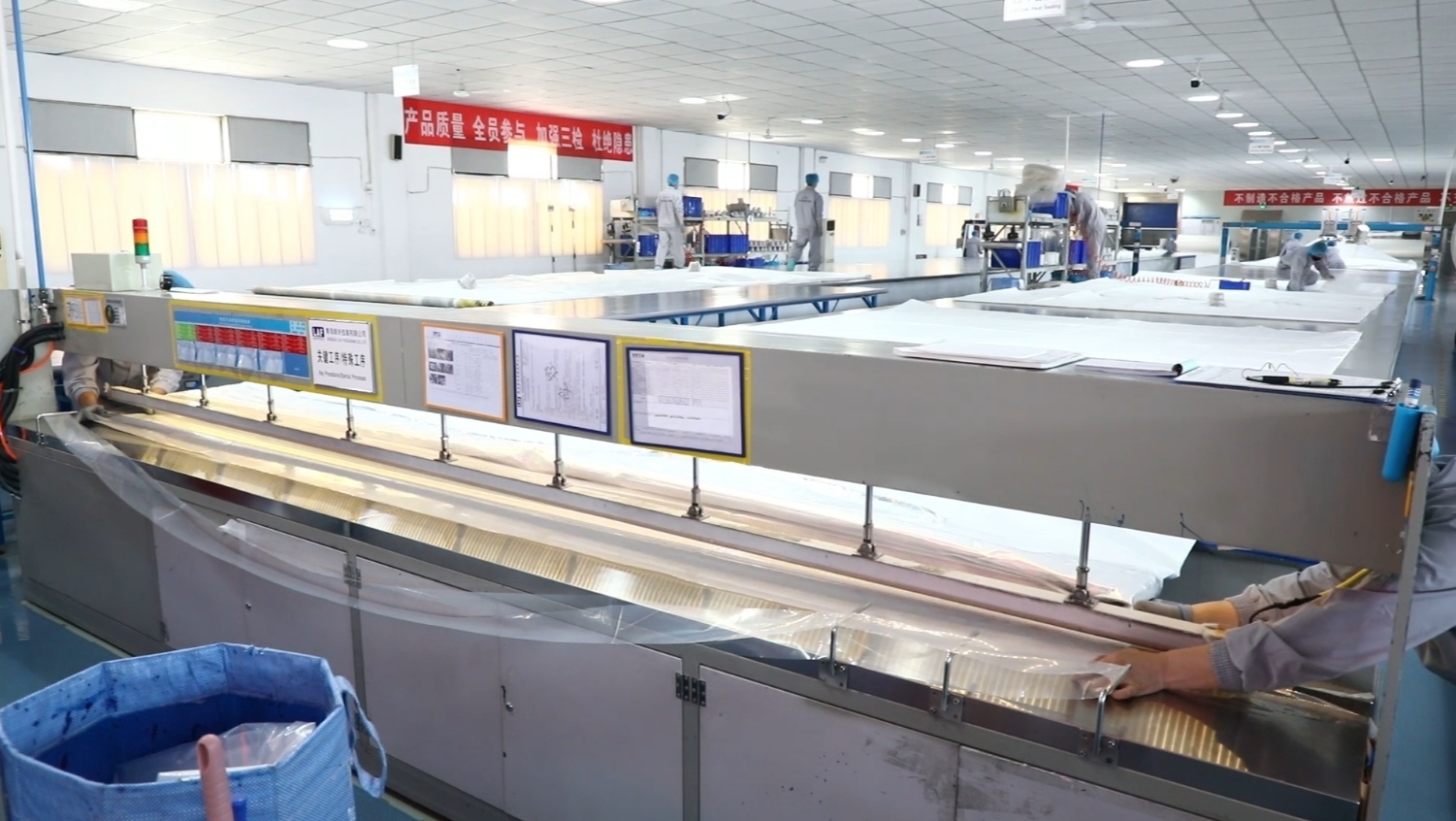
LAF Technology Flexitank Factory, Qingdao, China
| Traditional Packaging Mindset | Modern Flexitank Engineering Mindset |
|---|---|
| Focus on simple containment | Focus on integrated logistics performance |
| One-size-fits-all packaging | Scenario-specific product engineering |
| Limited consideration of transport conditions | Engineering based on road, rail, sea, and environmental stress |
| Packaging viewed as passive | Packaging viewed as active logistics system |
| Minimal field feedback integration | Continuous feedback from technical support and service networks |
Why Real Transport Conditions Matter
One of the most important shifts in modern flexitank development is the recognition that transportation conditions directly influence packaging performance. In real-world logistics, cargo does not remain static. Liquids move continuously inside the container during acceleration, braking, turning, vibration, rail impacts, sea motion, and uneven road conditions.
This movement creates dynamic stress inside the transport system. A flexitank must therefore withstand far more than static weight. It must absorb pressure changes, maintain sealing integrity, resist puncture risk, tolerate vibration fatigue, and preserve cargo stability throughout the entire logistics journey.
For example, a shipment traveling only a short distance on smooth highways may experience relatively controlled movement conditions. In contrast, cargo traveling through mountainous regions, long railway routes, or damaged industrial roads may face continuous vibration and sudden force shifts over extended periods. These operational realities require different engineering approaches.
Scenario-based engineering addresses this challenge by studying how packaging behaves under actual transport conditions rather than ideal laboratory assumptions alone.
Key Principle
In bulk liquid logistics, packaging performance cannot be separated from transport conditions. The route itself becomes part of the engineering challenge.
The Role of Material Science in Flexitank Performance
Material science forms the foundation of modern flexitank engineering. Different transport scenarios require different material behaviors. Some applications prioritize puncture resistance. Others require oxygen barriers, food-grade compatibility, friction resistance, thermal stability, or sealing toughness.
In high-temperature applications, material selection becomes especially critical. A flexitank transporting heated cargo must tolerate elevated temperatures without compromising structural integrity or cargo quality. Heat resistance alone is not enough. The material must also maintain sealing performance, flexibility, and durability throughout loading, transportation, and unloading operations.
Meanwhile, low-temperature transportation introduces different risks. Cold environments can affect flexibility, impact resistance, and material fatigue behavior. Engineering teams must therefore understand how materials respond not only to cargo, but also to climate and transportation duration.
Modern flexitank development increasingly combines material science with operational data. Rather than selecting materials based only on theoretical performance, engineering teams analyze how materials behave under real logistics conditions over time.
Multimodal Logistics and Packaging Complexity
One of the biggest challenges in modern logistics is multimodal transportation. Cargo frequently moves through combinations of road, rail, and sea transport before reaching its final destination. Each transport mode introduces different forms of stress.
Road transportation may involve vibration, braking force, turning stress, and uneven surfaces. Railway transportation introduces repeated impact forces, track vibration, and long-distance movement cycles. Maritime shipping creates rolling motion, container stacking pressure, and prolonged exposure to changing environmental conditions.
A flexitank designed for multimodal transport must therefore function across all these environments without compromising cargo safety or operational efficiency.
This is why scenario-based engineering is becoming increasingly valuable. Instead of optimizing products for only one transport condition, the engineering process studies the complete cargo journey. The flexitank becomes part of a broader logistics ecosystem rather than a standalone packaging item.
Modern Logistics Reality
The same cargo shipment may experience highways, railway terminals, container yards, ports, ocean transport, and destination unloading facilities within a single logistics cycle. Packaging systems must therefore be engineered for continuity across multiple operational environments.
Why Technical Support Is Part of Engineering
In advanced bulk liquid logistics systems, technical support is not separate from product engineering. It is part of the engineering process itself.
A technically advanced product can still experience operational issues if installation, loading, or unloading procedures are not properly understood. Container preparation, filling procedures, valve handling, cargo compatibility, and discharge methods all influence overall system performance.
This is why modern flexitank operations increasingly integrate technical support into the logistics workflow. Technical teams provide guidance during container selection, flexitank installation, cargo loading, unloading operations, and product usage procedures.
More importantly, technical support teams become a valuable source of operational feedback. Field observations help engineering teams identify recurring issues, route-specific challenges, operator behavior patterns, and product improvement opportunities.
Over time, this creates a continuous improvement loop where operational experience directly contributes to future product development.
How Digital Technology Is Reshaping Product Development
Digital technology is becoming increasingly important in industrial packaging engineering. Modern product development no longer depends solely on physical prototyping and trial-and-error methods. Engineering teams now use digital simulation tools, structural modeling, performance analysis, and finite element evaluation to study how packaging systems behave under stress.
These technologies allow engineers to evaluate force distribution, structural behavior, pressure concentration, and movement patterns before large-scale production begins.
Digital analysis is especially valuable in flexitank development because liquids behave dynamically during transport. The interaction between liquid movement, container structure, material flexibility, and transport force creates highly complex mechanical behavior.
By integrating digital technology into product development, engineering teams can identify weak points earlier, improve structural performance, optimize material distribution, and refine product reliability more efficiently.
| Technology Area | Contribution to Flexitank Engineering |
|---|---|
| Finite Element Analysis | Studies structural stress distribution and mechanical behavior |
| Digital Simulation | Models transport conditions and liquid movement patterns |
| Materials Research | Improves strength, flexibility, and compatibility performance |
| Testing Techniques | Validates performance under operational stress conditions |
| Process Technology | Enhances sealing consistency and manufacturing quality |
The Increasing Importance of Food Safety
Food-grade cargo transportation has introduced additional engineering expectations for bulk liquid packaging systems. Beyond structural performance, packaging must now support contamination control, hygiene standards, regulatory compliance, and cargo purity protection.
Edible oils, beverages, wine, and food ingredients require careful attention to oxygen resistance, moisture control, sealing reliability, and material compatibility. Even small contamination risks can have serious commercial and regulatory consequences.
As a result, modern flexitank engineering increasingly integrates food safety considerations directly into product development. Material selection, production environment, valve systems, loading procedures, and technical guidance all contribute to overall cargo protection.
This shift demonstrates how industrial packaging has evolved beyond simple transportation. Packaging systems are now expected to support broader supply chain quality assurance objectives.
Efficiency Is Becoming an Engineering Objective
In the past, logistics packaging was often evaluated mainly in terms of cost. Today, efficiency itself has become an engineering target.
Modern supply chains are under pressure to reduce loading time, improve unloading speed, maximize container utilization, reduce handling complexity, minimize waste generation, and optimize warehouse usage.
Flexitank systems contribute to these objectives by enabling high-volume bulk transport within standard shipping containers. Compared with rigid packaging systems, flexitanks can improve loading capacity while reducing the number of handling units involved in transportation.
Engineering teams therefore increasingly study not only structural performance, but also operational efficiency. Product design now considers filling procedures, discharge systems, installation speed, transport coordination, and storage efficiency as part of the overall logistics solution.
Operational Perspective
In modern logistics, efficiency improvements often create value not only through lower cost, but through reduced handling complexity, faster cargo movement, improved scheduling flexibility, and more predictable supply chain operations.
Sustainability and Circular Logistics Systems
Sustainability has become another major driver of innovation in bulk liquid logistics. Companies increasingly seek packaging systems that reduce waste generation, improve transport efficiency, support recycling initiatives, and lower environmental impact across the supply chain.
Flexible bulk packaging systems can contribute to these objectives by reducing dependence on rigid containers, minimizing cleaning requirements, reducing empty return logistics, and improving transport utilization efficiency.
Circular economy thinking is also influencing product development. Instead of focusing only on immediate transportation performance, engineering teams increasingly evaluate material recyclability, waste management practices, operational reuse systems, and long-term environmental impact.
This broader sustainability perspective is reshaping how industrial packaging systems are designed, manufactured, and integrated into global logistics operations.
The Future of Flexitank Engineering
The future of flexitank technology will likely become even more integrated with data analysis, advanced material science, logistics modeling, and digital engineering systems. As supply chains become more complex, packaging systems will increasingly be expected to deliver not only cargo containment, but operational intelligence, sustainability support, and risk reduction.
Scenario-based engineering will continue playing a central role because logistics conditions are becoming more diverse rather than less. Global trade routes, environmental conditions, transportation infrastructure, and customer expectations continue evolving.
The companies that succeed in this environment will likely be those that treat packaging not as a commodity, but as an engineered logistics platform capable of adapting to real-world operational complexity.
Engineering Beyond Packaging
Modern flexitank systems are no longer defined only by their ability to hold liquid cargo. They are increasingly defined by how effectively they perform across real transportation environments, support operational efficiency, integrate with multimodal logistics systems, protect cargo quality, and adapt to changing industrial requirements. Scenario-based engineering represents a shift from viewing packaging as a static product toward understanding it as a dynamic component of the global logistics ecosystem.